The Barcelona issue
The Architects Who Refused to Let Gaudí Have Barcelona
Domènech i Montaner and Puig i Cadafalch spent thirty years competing with Gaudí, building by building. Here is where to read the whole quarrel, mostly without the queues.

By Robin MeijerNeighbourhoods, sights and the slow way round the city

The stretch of Passeig de Gràcia between Carrer d'Aragó and Carrer del Consell de Cent takes about ninety seconds to walk. In 1900 it held three of the most expensive arguments in Europe, built shoulder to shoulder by architects chasing the same industrialist clients and the same unsettled question: what a modern Catalan building should look like. Barcelona sells you one of those architects on every postcard. This route hands you the other two, and it is quieter, cheaper and in places better.
Start on the block that gave the feud its name
Barcelona called it the Illa de la Discòrdia, the block of discord, and the nickname was not affectionate. Within a few years either side of 1900, three rival architects remodelled three adjoining houses for three rich families who wanted to out-build each other in public. Two of those façades still touch, and five free minutes on the pavement opposite tell you more about the rivalry than any ticket will.

Casa Amatller (Passeig de Gràcia, Dreta de l'Eixample) is Josep Puig i Cadafalch's contribution, finished in 1900 for the chocolate manufacturer Antoni Amatller. The stepped gable is northern European, the doorway is Catalan Gothic, and the whole house argues that a modern Catalonia should look like a confident medieval one. The reason to go inside is the apartment rather than the staircase: the Amatller family rooms survive largely as they were left, furniture, kitchen and photographic studio included, and it is the best-preserved 1900 interior on the street. Tours run in seven languages at €15 to €30 depending on format, with the chocolate tasting and photographic-studio versions at the top of that range. Group visits are bookable seven days a week with their own pricing, and the dramatised and educational formats work well for families and private parties. Couples and serious architecture visitors should take the plain guided tour and skip the theatre.

Casa Batlló (Passeig de Gràcia, Eixample) is Gaudí next door, remodelling an existing block between 1904 and 1906, and it was designed to out-shout the neighbour. It succeeded, which is the honest problem with visiting it. Entry runs €29 general, €38 silver, €43 gold and €53 platinum, doors are open 9:00 to 22:00 daily, and it is comfortably the most crowded house on this block. Take the first or last slot of the day. The upper tiers mostly buy queue priority and extras rather than more building, so pay for silver if you hate waiting and stop there. The near-nightly rooftop concerts from March through the summer are the pleasant way onto that roof without somebody's elbow in your ribs. For large parties it is the most capable house here, with high capacity, skip-the-line entry and flexible options.
Plan your Barcelona trip
Live prices from our booking partners.
Free cancellation on many rooms. We may earn a commission when you book.
The first Modernista building in the Eixample was not a Gaudí
One block up, Fundació Antoni Tàpies (Carrer d'Aragó, Eixample) settles a point most Gaudí tours never raise. Lluís Domènech i Montaner built it in 1885 as the Montaner i Simon publishing house, in exposed brick and frankly exposed iron, and it predates almost everything on the standard trail. Gaudí was not the first mover here, only the loudest. Entry is €12 adult, €8 for students and over-65s, free for children, open Tuesday to Saturday 10:00 to 19:00 and Sunday 10:00 to 15:00. It is a small museum, with about twenty people a comfortable ceiling, so it suits couples and small groups rather than coaches. The tangle of wire and tube on the roof is Tàpies answering the building a century later, which is very much in the spirit of the place.

Domènech i Montaner built the strongest rebuttal
If one building disproves the idea that Gaudí won Modernisme uncontested, it is the Palau de la Música Catalana (Sant Pere, Ciutat Vella). Domènech i Montaner built it for a choral society between 1905 and 1908, and it is still the only Art Nouveau concert hall on UNESCO's World Heritage list. The auditorium takes daylight through walls of stained glass and an inverted glass skylight that hangs into the room like a dropped sun; nothing on the Gaudí circuit does anything comparable with light. Visits run all day: €20 self-guided, €24 guided, €30 for the Essence Palau format, and premium slots from €120 including the private-guide Palau Exclusive option. There are dedicated choir-group and accessible-group visits, and large parties get their own guide rather than being folded into a public tour. Book the slot online. Walking up and hoping is how people end up looking at the ticket hall.


Recinte Modernista de Sant Pau (El Guinardó, at the top of Avinguda de Gaudí) is his life's work and the largest Art Nouveau complex in the world: twenty-seven acres of pavilions, mosaic, tilework and service tunnels, built as a working hospital on the theory that beauty and daylight were medical equipment. He also set the whole site on a deliberate diagonal, aimed down the avenue at the Sagrada Família. The rivalry is written into the street plan, and you can stand in the gate and see it. Self-guided entry is €17 to €18, €11 for 12 to 29s and over-65s, €21 guided, free under 12, with group and school rates by booking. This is the one site on this list that absorbs a coach party without strain. Give it half a day and wear real shoes.
Palau Montaner (Carrer Mallorca, Eixample) is the hardest ticket and the most revealing. Domènech i Montaner inherited the commission mid-build, after the original architect, Josep Domènech i Estapà, fell out with the owner. It is the clearest surviving proof that these men were competing for the same jobs rather than conducting a polite stylistic debate. Guided tours run the second Saturday of each month at 10:30, about ninety minutes, €12 per person, reservation required up to ten days ahead on 652 88 24 57. Capacity is tiny; a group of ten effectively takes the whole slot, so book it as a block or don't bring the group.

Puig i Cadafalch answered with the Middle Ages

Where Gaudí went organic, Puig i Cadafalch went hard medieval, and he meant it as a rebuttal rather than a retreat. Palau Baró de Quadras (Avinguda Diagonal, Eixample) is him at his most aggressive about it: a Diagonal façade of carved stone knights and grotesques two blocks from Gaudí's curves. The building is now the Institut Ramon Llull's headquarters, so it is a workplace first. Guided tours run Fridays only, 10:30 in Spanish and 12:00 in Catalan, forty-five minutes, with limited places. Tickets are €10 adult, €9 concessions, €7 for children 7 to 12 and free under 7; groups over ten and anyone wanting a private tour must arrange it in advance.
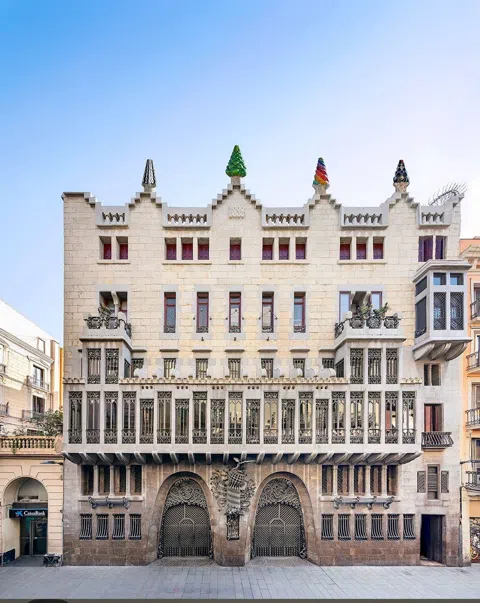
Palau Macaya (Passeig de Sant Joan, Eixample) is the insider stop and it is free. It runs as a cultural centre with three permanent displays on Modernisme and on Puig i Cadafalch himself, the only place in the city that tells his side of the story as a standing exhibit rather than a footnote. Guided tours of the façades, courtyard, carriage yard and noble floor run Fridays at 19:00 from 19 June to 4 September 2026, in Catalan during the first half of each month and Spanish during the second. Check the dates before you build a day around it; the guided programme is seasonal and the centre itself is open far more often than the tours are.

CaixaForum Barcelona (Montjuïc, Sants-Montjuïc) carries the other half of the argument. Puig i Cadafalch's 1911 Casaramona textile factory is Modernisme doing industry and civic duty: brick, rhythm, ventilation, no saints. It is the side of the movement the Gaudí tours skip. Entry is €6, free for ICOM members, open 10:00 to 20:00 daily and until 23:00 on Wednesdays in July and August. The halls are large, groups are easy, and the factory roof is visitable. At six euros it is the best-value Modernista interior in Barcelona and nothing else is close.

What Gaudí was doing while they argued
Do not skip him. The rivalry only reads properly if you see what the other two were up against, and 2026 is the year to do it.
Basílica de la Sagrada Família (Sagrada Família, Eixample) finished its central Tower of Jesus Christ in February 2026, and Pope Leo XIV blessed it on 10 June, the exact centenary of Gaudí's death. The building is now the tallest church in the world. Tickets are €26 for the basilica and €36 with tower access, plus a €2 to €5 centenary surcharge from June to December 2026; the audio guide is included and there are separate group and guided tiers. Book weeks ahead. Demand this year is at a record and same-week slots essentially do not exist.

Casa Milà — La Pedrera (Passeig de Gràcia, Eixample) earned its nickname, the quarry, as mockery from Gaudí's own contemporaries, which is exactly why it belongs in a piece about how contested he was. Daytime Essential entry is €25; the €39 Night Experience puts a light show on the chimney roof and ends with a glass of cava. Take the night version if you can. The roof is better after dark and it books naturally as a group.

Palau Güell (El Raval, off the Ramblas) is around €12 and the quietest serious Gaudí interior in the city. Tickets are sold online only through entrades.palauguell.cat and released four days ahead, so work a rolling booking window rather than planning it months out. The rooms are small; split a large group across slots or arrange a guided visit. It is the clearest look at what industrialist money actually bought while all three architects were courting the same patrons.

Casa Vicens (Gràcia) is his first house and openly Moorish-Mudéjar rather than Catalan-Gothic, proof that the three of them were arguing about national identity and not wallpaper. Entry is €21 standard, €23 guided and around €40 for early access before general admission, which is worth the premium in high season. Weekend slots sell out fast.

The rooms where the argument actually happened

Els Quatre Gats (Barri Gòtic) occupies Puig i Cadafalch's Casa Martí, and from 1897 its tavern room is where Picasso, Ramon Casas and Santiago Rusiñol talked Modernisme into being. Be clear-eyed: it is famous first and a restaurant second. The menu is mid-range Catalan, coffee and vermouth cost bar prices, and the tables are tight. Reserve by phone or online, and do not turn up with ten people expecting to be seated.
Fonda España (El Raval) is the better meal. Domènech i Montaner's 1900 dining rooms reopened on 6 May 2026 under Martín Berasategui, with Edu Rodas running the kitchen, and the two historic salons take private parties. Prices are fine-dining, tasting or à la carte. One practical trap: the hotel now trades as Hotel España Ocean Drive, so book under that name, by phone on 93 218 30 00 or through OpenTable. The Sky Bar handles pre-dinner drinks for a group.

Hotel Casa Fuster (top of Passeig de Gràcia, Gràcia) was Domènech i Montaner's last Barcelona building and the most expensive house in the city when it went up. It is the only building on this trail you can sleep inside, at 5-star GL rates. The cheaper way in is Café Vienès, whose Thursday jazz sessions take groups if you reserve a table and cost roughly what a cocktail bar costs. There are 105 rooms and function space if you are moving a larger party. If you would rather sleep somewhere less operatic, compare rates with a Barcelona hotel search.

Practical notes
Most of this is walkable. Passeig de Gràcia (L3) serves the block of discord and La Pedrera; Sagrada Família (L2, L5) is one stop from Sant Pau | Dos de Maig (L5) for the Recinte; Espanya (L1, L3) drops you below CaixaForum; Fontana (L3) is closest to Casa Vicens; Liceu and Drassanes (L3) cover Palau Güell and Fonda España. A ten-journey multi-trip card is far cheaper than singles if you are doing three or more hops a day.
Cards work everywhere, including contactless on the metro, but carry €20 in small notes and coins for the smaller ticket desks and neighbourhood cafés. Timing is what constrains the route. Friday is the linchpin day, with Palau Baró de Quadras at 10:30 and 12:00 and Palau Macaya's guided tour at 19:00 in season. Palau Montaner runs only on the second Saturday of the month. Book Sagrada Família weeks out and Palau Güell exactly four days out.
On budget, a Gaudí-only day (Sagrada Família with towers, Casa Batlló, La Pedrera) comes to roughly €90 to €100 a head before food, and most of it is spent standing in line. The rival day, Palau de la Música guided at €24, Sant Pau at €17, CaixaForum at €6 and Palau Macaya free, lands near €47, sees more building and involves almost no queueing. Do both if you have three days. If you have two, do the second one first. For everything else in the city, start with our Barcelona guide.
Before you go
Who were Gaudí's main rivals in Barcelona?
Lluís Domènech i Montaner and Josep Puig i Cadafalch. Domènech i Montaner built the Palau de la Música Catalana and the Recinte Modernista de Sant Pau; Puig i Cadafalch built Casa Amatller, Palau Baró de Quadras, Palau Macaya and the Casaramona factory that now houses CaixaForum. All three competed for the same industrialist clients between roughly 1885 and 1910.
Can I see the non-Gaudí Modernista buildings without booking weeks ahead?
Mostly yes. CaixaForum (€6) and Palau Macaya (free) take walk-ins. Palau de la Música and Sant Pau usually have slots within a few days. The exceptions are Palau Baró de Quadras, which only runs guided tours on Fridays, and Palau Montaner, which opens for one tour on the second Saturday of each month and needs a phone reservation up to ten days ahead.
Is the Sagrada Família worth it in 2026 with the extra surcharge?
Yes, if you book weeks ahead. The central tower was finished in February 2026 and blessed on 10 June, the centenary of Gaudí's death, and it is now the tallest church in the world. Entry is €26, or €36 with tower access, plus a centenary surcharge of €2 to €5 from June to December 2026. Demand this year is at a record, so same-week tickets are effectively unavailable.
Which Modernista sites work for a large group?
Recinte Modernista de Sant Pau is the easiest, 27 acres with group and school rates. Palau de la Música gives large parties their own guide, Casa Batlló has real capacity with skip-the-line options, and CaixaForum has big halls at €6. Do not bring a large group to Palau Güell, Palau Montaner or Els Quatre Gats without splitting it or booking the whole slot.
What is the cheapest way to see a good Modernista interior in Barcelona?
CaixaForum at €6, in Puig i Cadafalch's Casaramona factory, with a visitable roof and long daily hours. Palau Macaya is free and holds three permanent displays on Modernisme. Both are far better value than the €29-plus house museums on Passeig de Gràcia.