Spécial Barcelona
Barcelona's Eixample in October Without the Queues
October is the month when L'Eixample's Gaudi houses, the basilica and the grid itself all come at walking pace. Here is the order to take them in, what you pay, and what you can skip for free.

Par Robin MeijerNeighbourhoods, sights and the slow way round the city

Stand on the corner of Passeig de Gracia and Carrer d'Arago on an October afternoon and the first thing you notice is underfoot: grey hexagonal tiles, a sea-fan and a starfish and a nautilus cast into each one, repeating up the boulevard until the pattern stops being a floor and starts being a map. The second thing you notice is that the line outside Casa Batllo is a line, not a siege. This is the easiest month of the year to read Gaudi's grid, and apart from one hill you can leave for later, the walking is flat.
Cerda's grid, read from the pavement
L'Eixample means the extension, and that is exactly what it is: the orthogonal city laid out from the 1860s to stitch the cramped old town to the villages above it. The one idea you need before you set off is the chamfer. Every block has its four corners cut back at forty-five degrees, so each junction opens into a small octagonal plaza instead of a blind right angle. Once you have seen one you cannot unsee them, and the whole district reads as a lattice of little squares rather than a series of streets.
Passeig de Gracia (the spine of L'Eixample, running from Placa de Catalunya up to Diagonal) is free, public and an exhibit before you have paid for anything. The lamp-posts with their mosaic benches and the flower-tile paving are listed design in their own right, so you are already looking at the good stuff while you walk between tickets. Take it uphill from the Placa de Catalunya end and keep to the building side: the central pavement is tight at rush hour, and the bike lane is not an overflow footpath. If you are walking with a group, string out in twos rather than standing in a ring. Guides here spend half their energy keeping parties out of the cyclists' way.
Préparez votre voyage à Barcelona
Prix en temps réel de nos partenaires de réservation.
Annulation gratuite sur de nombreuses chambres. Nous pouvons percevoir une commission lorsque vous réservez.
Three houses on one block and which one to pay for
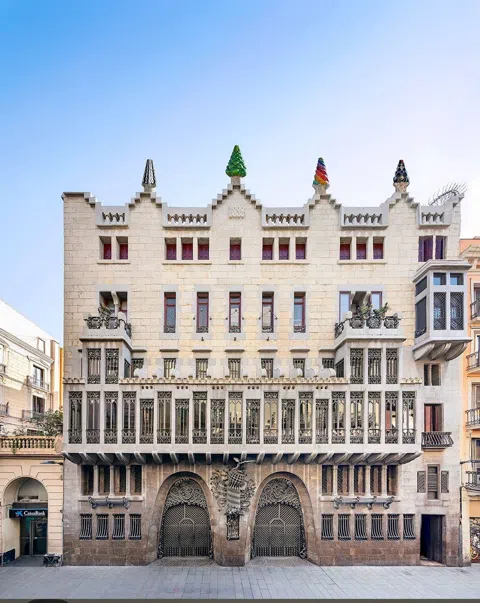
The stretch between Carrer del Consell de Cent and Carrer d'Arago is the Illa de la Discordia, where three architects built next to each other and visibly refused to agree.
Casa Batllo (Passeig de Gracia, Illa de la Discordia) is the theatrical one: the scaled facade, the bone-coloured balconies, the blue light-well that darkens as it rises. Standard entry runs from €29 for the Blue ticket to €53 for Platinum, with early-access Be the First slots from €45 and Magical Nights, which add a rooftop concert, from €55. It stays open until 22:30 every day, and that single fact is the most useful thing about it: you can spend your daylight outdoors and still do the big interior at nine in the evening. Be warned that the stair and light-well are single-file, so parties of more than a handful get split into waves and will not stay together inside.
Casa Amatller (next door, same block) is the better-value interior and far quieter, which matters more in October than people expect: the boulevard thins out, but Batllo does not. Tickets run €15-30 depending on the tour type, youth aged 8-25 pay €20 and under-sevens are free. Guided slots are fixed and timed: English at 10:00, Spanish at 11:00, Catalan at 12:00, with the house open 10:00-20:00 almost every day of the year and a chocolate tasting on Friday evenings at 18:00. Groups and school parties are arranged directly with the museum. Casa Lleo Morera, the third of the trio, remains shut, so if you want one paid interior on this block and you dislike standing in line, this is the one.

Up the boulevard to Casa Mila and a free palace
Keep walking uphill four blocks and the stone goes soft. Casa Mila – La Pedrera (Passeig de Gracia at Provenca) is the quarry-faced apartment building with no straight line in its facade and the chimney soldiers on the roof. The self-guided Essential visit is around €25-30; the Night Experience is €39.50 for adults and €19 for 12-17s, and includes rooftop video-mapping and a glass of cava. Allow an hour to ninety minutes. Guided tours in several languages can be arranged for groups, but book early: rooftop capacity, not the ticket desk, is the bottleneck. Two caveats worth knowing. The rooftop and mezzanine cannot be made accessible, so wheelchair users will see a partial house; and while the building takes a handful of closure days in 2026, none of them fall in October (they are 6 July, 7 September and 25 December).
At the top of the boulevard, Palau Robert (Passeig de Gracia at Diagonal) is the stop nobody sells you and everybody should take. Entry is free and unticketed, the exhibitions change through the year ('Un teatre Lliure' runs until 17 January 2027), and behind the building there is a garden that is the best free sit-down on the whole street. Opening is Monday to Saturday 9:00-20:00 and Sunday and holidays 9:00-14:30, which is worth noting if your trip straddles the 12 October public holiday. Groups walk straight in, and the garden swallows a party far better than the rooms do.

Wednesday or Saturday for the Diagonal interior
Palau Baro de Quadras (Avinguda Diagonal, a short block east of Palau Robert) is the one Puig i Cadafalch interior on Diagonal you can actually get inside, and it is the stop most itineraries miss because the access window is narrow. Interiors open on Wednesdays and Saturdays only, on fixed slots: English at 11:00, Catalan at 12:00, Spanish at 13:00. Entry is €14 adult, €12.60 reduced, €6 for ages 7-12 and free under seven; groups of fifteen or more pay €12 a head. Plan your week around it or accept you are only seeing the facade, which carries the best stone carving on the avenue.
The basilica in its centenary year
Basilica de la Sagrada Familia (Eixample Dret, fifteen minutes' walk east of Casa Mila) is the one unavoidable ticket. Entry is €26 for the basilica, €36 with the tower lift, €30 guided and €40 guided with towers; under-elevens go free. Group rates start at €30 a head on the guided tariff and school groups pay €15 a student with teachers free. Everything is timed and must be pre-booked. Official tickets routinely go two to four weeks ahead, and there is no door queue worth joining as an alternative. 2026 is the centenary of Gaudi's death and the year the central tower was finished, blessed in June in front of 120,000 people, so the building is drawing more attention than usual. Book it the day you book your flights, not the week you arrive.
Most visitors stop there. Walk ten minutes up Avinguda Gaudi, a diagonal cut straight through the grid, with the basilica at your back and the towers of the hospital rising ahead, to Sant Pau Recinte Modernista (northern edge of L'Eixample at Guinardo). It is a UNESCO-listed complex of pavilions, tiled wards and tunnels, and it has essentially none of the crowding of the basilica. Self-guided entry is €18 before 14:00 and €17 after, guided tours are €21 and the audio guide is €4. It opens daily 9:30-18:30 through October. The two free-entry days, 23 April and 24 September, fall outside October, so budget for a ticket, and check the site before you go, because parts of it close for private events.

Seeing the grid as a grid
From street level the chamfered corners are a detail. From above they are the whole design. Mirador Torre Glories (Glories, eastern L'Eixample) is the only place you can look down and watch Cerda's lattice resolve into octagons, from the 30th floor. General admission starts at €18, €22 with the Cloud Cities installation, and an open-date ticket is about €20. Reservations are required and timed; Cloud Cities is for ages 8 and up with under-13s accompanied; group bookings go through email or phone. The October detail that catches people out: it runs 10:00-21:00 only until 15 October, and after that switches to Wednesday to Monday, 10:00-18:30. If you arrive late in the month, that is a closed Tuesday and a sunset you will miss.
Park Guell (Monumental Zone) (Gracia hillside, above L'Eixample) is not in this district at all, but it is bolted onto nearly every full-day Gaudi itinerary, so plan it deliberately. The Monumental Zone is €18 adult, €13.50 child, free under seven, on timed 30-minute entry windows capped at 1,400 visitors an hour; October is still high season with 9:30-19:30 hours, so book the official site three to five days ahead. Groups must all hold the same slot and arrive inside it; late tickets are void with no refund, which is a brutal rule if your taxi gets stuck. On a short trip I would take the free alternative: the surrounding woodland and the Carmel and Calvary viewpoints are unticketed and higher, and the city view from them is better than the one from inside the paid enclosure. Pay for the Monumental Zone if you came for the mosaic bench and the dragon stair. Skip it with a clear conscience if you came for the view.
Where to eat without losing the afternoon
Mercat de la Concepcio (Carrer d'Arago, two blocks east of the Illa de la Discordia) is the one stop on this walk where locals outnumber visitors. Browsing is free, and the bars inside do tapas and coffee for roughly €3-12. The flower stalls on Valencia trade round the clock every day of the week; the food hall closes on Sundays. Small guided food groups are normal here, but a large party in the aisles at the 8:00-10:00 shopping peak is a nuisance to people doing their actual weekly shop.
Cerveceria Catalana (Carrer de Mallorca, two streets off Passeig de Gracia) is the default tapas stop and takes no reservations at all. A host works the pavement queue, so anything above four people should expect to be split or to wait thirty to sixty minutes. It is open 8:30-01:30 daily; arrive at 12:45 on a weekday or at 18:00 for dinner and sit at the counter rather than holding out for a table. Plates run roughly €4-15.
Cafe del Centre (Girona 69, Eixample Dret) has been trading continuously since 1873 and is council-listed as emblematic, with Victor Ferrer in the kitchen now and weekly jazz nights. Reckon on €25-45 a head for author tapas or the tasting menu, book online, and note that it does not open until 13:00, so this is a late lunch or an evening, never a morning coffee. The whole room can be taken for private events.
For the view with a drink in it, La Dolce Vitae at Majestic Hotel & Spa (Passeig de Gracia) has the highest open-air terrace directly on the boulevard, with a food menu overseen by Nandu Jubany and breakfast service added in 2026. Non-residents are welcome but terrace tables are limited, so book; cocktails are around €22. It is dear, and the Sagrada Familia sightline is distant rather than head-on. What you are paying for is the grid at golden hour, which is worth one round and not three.

A roof for the wet hour
October can hand you an hour of hard rain. Museu Egipci de Barcelona (Carrer de Valencia, two minutes from Casa Mila) is the district's main surviving museum now that the Museu del Modernisme has gone for good, and it is a genuine fallback rather than a consolation: €14 general, €10 reduced for students, over-65s, unemployed and disabled visitors. Group and school visits are arranged by phone or email, and the galleries are small enough that parties get staggered. One trap: on weekdays it shuts for lunch, 14:00-16:00.

Guided or on your own

If you want orientation before you spend money, Runner Bean Tours (departs Placa Reial, old town) runs an independent, locally guided Gaudi walk daily at 11:00 for about two and a half hours. It is capped at twenty people, reservation is essential, it works on tips, and metro fares are not included. It covers exteriors only, no interiors, which makes it the cheapest honest way to decide which house you actually want to pay to enter.
Full-day guided combinations that bundle the basilica, a Gaudi house and the hillside park do exist and are attached to this page separately. They run seven days a week and start from about 160 USD per person, and the booking platform flags the top one as likely to sell out, so if you want a guide on a fixed date, treat it like the basilica ticket and lock it early. The case for paying is logistics rather than knowledge: one timed slot missed on a self-planned day can cost you two others. The case against is that every interior here sells its own guided ticket more cheaply, and the walking between them is pleasant, legible and free.
Best time to go in October
October is the easiest month to do this district properly. The city does not empty; the heat goes, and the daylight is still long enough to put two interiors and a rooftop into one day. Start at 9:30 or 10:00 with whichever paid interior you booked; the first ninety minutes of the day are reliably the thinnest inside the houses. Keep 13:00-15:00 for the market or a sit-down, because that is when the boulevard is at its most congested and the light is at its flattest. Put your viewpoint at the end: before 15 October you can still be up Torre Glories at sunset, and after that date the 18:30 close pushes your view into the afternoon and takes Tuesdays off the table entirely.
By day of week: Wednesday and Saturday are the only days the Diagonal palace interior opens; Sunday closes the market food hall; Casa Batllo's 22:30 close gives you a late option any night. If your dates include the 12 October public holiday, assume holiday hours on the free sites: the free exhibition centre at the top of the boulevard drops to a 9:00-14:30 morning.
Is it worth it
Yes, with one qualification: L'Eixample is worth a full day on foot and a strict budget on tickets. Much of the district costs nothing, and that free layer (the paving, the chamfered corners, the facades on the Illa de la Discordia, a free exhibition and a garden at the top of the street) is a large share of the experience, so the paid interiors are a choice rather than a toll. Two paid interiors plus one viewpoint is the shape that works. Four interiors in a day turns into a queue-management exercise and you stop looking up.
It suits couples and solo walkers best, because almost every door here is a timed slot or a single-file stair. It suits families well if you plan around the free under-seven entries and the lunch closures. It is hardest on groups: the basilica, the hillside park and the viewpoint all demand one shared timed slot, the best tapas bar takes no reservations, and the most photographed house splits big parties into waves. Groups should pre-book everything, and where a group rate exists, ask for it.
Practical notes
Transport is straightforward: metro lines converge on Passeig de Gracia, Diagonal and Sagrada Familia, and the whole walk above is flat except for the hillside park, which needs a bus, a taxi or a stiff climb. Everything else sits within about twenty-five minutes' walking of the Illa de la Discordia, and if you are choosing where to sleep, the grid is where the walking day begins and ends; see the Barcelona hotel search for the blocks between Placa de Catalunya and Diagonal.
Cards work everywhere, including market bars, but carry €20-30 in cash for stalls and tips, and if you take the tip-based walking tour, decide your amount before you start. On budget: a lean day is free (pavement, facades, the free exhibition centre and garden, the market, the hillside viewpoints) plus a €4-15 tapas lunch. A standard day is around €26 for the basilica, €15-30 for the quieter house on the Illa de la Discordia and €18 for the viewpoint, with lunch at the market. A big day with the basilica towers, a night visit to a Gaudi house and a rooftop cocktail will clear €100 a head before dinner. Book the basilica weeks out, the hillside park three to five days out, and leave at least one afternoon with nothing in it. This is a district that rewards being walked twice. For the rest of the city, the Barcelona guide picks up where the grid stops.
Avant de partir
How long do you need for L'Eixample's Gaudi sights?
One full day on foot covers it if you are disciplined about tickets. The walking between Passeig de Gracia, Casa Mila and the Sagrada Familia is flat and takes under half an hour end to end, but each interior eats time: allow an hour to ninety minutes for Casa Mila, similar for Casa Batllo, and a timed slot you cannot move for the basilica. Two paid interiors plus one viewpoint makes a comfortable day. Four interiors turns the day into queue management.
Do you have to book Sagrada Familia tickets in advance for October 2026?
Yes. Every slot is timed and must be pre-booked, and official tickets routinely sell two to four weeks ahead. 2026 is the centenary of Gaudi's death and the year the central tower was completed and blessed, so demand is higher than usual. Entry is €26 for the basilica, €36 with the tower lift, €30 guided and €40 guided with towers, and under-elevens go free.
Can you see modernista interiors in L'Eixample for free?
Partly. Palau Robert at the top of Passeig de Gracia is free and unticketed, with changing exhibitions ('Un teatre Lliure' runs to 17 January 2027) and a garden that is the best free sit-down on the street. Beyond that, what is free is all exterior: the listed flower-tile paving and lamp-posts of Passeig de Gracia, the facades of the Illa de la Discordia, and the chamfered corners that make the grid legible. The houses themselves all charge.
Is a guided Gaudi tour better than visiting on your own?
It depends on what you are buying. A guide mostly buys you logistics: the basilica, the hillside park and the rooftop viewpoint all run on timed slots, and one missed slot can wreck two others. Full-day guided combinations run seven days a week from about 160 USD per person, and the top one is flagged as likely to sell out, so a fixed date needs booking early. Going on your own is cheaper and perfectly walkable, and a capped, tip-based local walk at 11:00 covers the exteriors if you only want orientation before choosing which house to enter.
Is Park Guell worth the timed slot, or is the free part enough?
The Monumental Zone is €18 adult and €13.50 child, free under seven, on 30-minute entry windows capped at 1,400 visitors an hour, and in October you should book three to five days ahead. Pay it if you came for the mosaic bench and the dragon stair. If you came for the view, the surrounding woodland and the Carmel and Calvary viewpoints are free, unticketed and higher, and your group will not lose its tickets for arriving ten minutes late.